The Whole Comes Before Form
“Design is not a practice of giving form to an object, but of deriving it from the whole.” When we create a product, we consider more than its function and shape. When we create a building, we consider more than its appearance and structure. We begin by observing the world and dimensions in which it exists, the history and philosophy behind it, the people involved, and the story we hope to create. People, organizations, businesses, culture, society, the environment, and time: through their relationships, they give meaning to its existence. Philosophy becomes strategy; strategy shapes organizations; organizations shape actions; actions become products and spaces; and these, in turn, become human experiences and memories. Nothing exists independently of everything else. It finds its meaning only through its relationship to a larger whole.
This is why we begin not with “What should we make?” or “Why should we make it?”, but with a more fundamental question: “In what kind of world does it exist?” From there, we seek to understand the whole to which it belongs. We consider the relationships and time surrounding its existence, reading its history, philosophy, and intentions for the future to discover what is needed. Philosophy, strategy, organizations, language, products, architecture, spaces, film, graphics, and websites are not merely deliverables for solving individual problems. As a story unfolds, they emerge from the necessity inherent in the whole at each moment. Rather than assembling a whole from its parts, we derive the parts from the whole. The whole comes before form. This reversal is the starting point of our practice. At Patmos, we call the practice of observing the whole, deriving the parts it requires, and shaping their relationships “Gestalting™.”
The Whole Exceeds the Sum of Its Parts
Yet thinking about the whole first does not, by itself, bring a meaningful whole into being. We create a philosophy. We create an organization. We create a product. We create architecture and spaces. However accomplished each part may be, without relationships between them, they do not emerge as a single whole. The coherence we sense in organizations with a rich, deeply rooted culture does not come from everything taking the same form. It comes from different parts—philosophy, strategy, organization, products, spaces, language, and behavior—supporting and transforming one another’s meaning while expressing a shared philosophy and set of values. When a philosophy lives not only in words but in everyday decisions and actions, encountering even a single part allows us to sense the whole behind it.
The whole is not the result of adding parts together. It emerges from the relationships between them. When one part changes, its relationships change, and so does the whole. When the whole changes, the meaning of each part changes in turn. These relationships are not fixed; they are continually renewed through people’s practices and the passage of time. Value does not exist in each part alone. As the parts resonate with one another, new value emerges that none possessed individually. To grasp the whole, then, is not to know every part. It is to observe the relationships behind the parts and seek to understand them as a whole. But how can we come to know a whole of which we ourselves are a part?
Truth as Cognition, Goodness as Will
As we continued to ask “What is the whole?”, we arrived at truth, goodness, and beauty—questions philosophy has explored since antiquity. How do human beings know the world, live well, and experience beauty? To grasp the whole, we must question not only the object itself, but how we perceive it, engage with it, and respond to it. The whole emerges in relation to us as beings who perceive, will, and feel. The world we see is not the world in itself. We cannot grasp the “thing-in-itself” directly; we understand the world through experience, knowledge, culture, and values. The biologist Jakob von Uexküll called the distinctive world that each living being perceives and gives meaning to its “Umwelt.” Even within the same world, humans and other animals see differently, as do human beings from one another. We are all within the whole, yet each of us sees only part of it through our own frame of reference.
For us, truth is therefore not the possession of a single correct answer. It is the effort to approach the whole that remains unseen by questioning our perception, without mistaking our own view for truth itself. Perception alone does not determine action. We also need the will to decide how we ought to be in relation to the world. Goodness is not about determining what is ethical or correct, but about the will to choose what is good in itself. Before considering outcomes, gain, or loss, we question how we ought to act toward others, society, and the future, and put that intention into practice. Here, goodness appears as “good will.” Truth concerns how we know the whole; goodness concerns how we exercise our will in relation to it. Through truth, we question our perception; through goodness, we take responsibility for our way of being within the whole. We see cognition and will as two foundations for engaging with the whole. Yet we do more than perceive and will: we encounter the world, sense harmony or dissonance, and sometimes feel beauty before we can explain it.
Beauty Emerges as a Whole
What, then, is beauty? When we try to create something beautiful, we turn our attention to visible parts: color, form, material, and proportion. But does beauty reside within those parts? Kant described beauty as “purposiveness without purpose.” Rather than finding something beautiful because it is useful, we sense harmony without presupposing a particular purpose—as though the parts and the whole were just as they ought to be. When we find a flower beautiful, we are not evaluating its function. We sense an order in its form, color, and balance that we cannot fully explain. Kant also distinguished between “free beauty,” which, like a flower, presupposes no purpose or concept, and “dependent beauty,” which, like design, does. What interests us is the human capacity to sense harmony before explaining it. The Earth exists within the universe, along with nature and ourselves. Even without fully understanding these relationships, we can sometimes sense order and harmony within them.
Beauty is a relationship between human beings and the world: how we sense the whole. It appears not only in visible forms, but also in character, behavior, and ways of living. Thought, will, and action, and the words and forms that emerge from them: when inner and outer life relate as one whole, beauty appears. Why, then, is beauty lost from the world we create? Modern society has developed by breaking functions down, measuring, improving, and optimizing them. Yet the rationality of the parts is not the same as the beauty of the whole. The absence of beauty is not a problem of form, but a loss of relationship between the whole and its parts. We do not set out to create beauty as an object. We observe the whole, derive the parts it requires, and bring them into meaningful relationships. When someone encounters that whole and feels that it is just as it ought to be, beauty emerges. We do not create beautiful forms; we create a whole in which beauty can emerge. This is our practice.
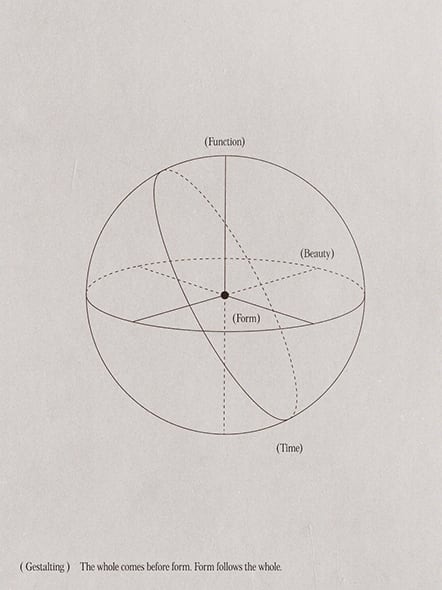
The Whole Emerges in Time and Across Dimensions
The whole we seek to grasp does not have a single, fixed form. The same thing appears in different aspects depending on the dimension from which we view it. Seen spatially, a building is a relationship between forms and materials; seen through everyday life, it is a setting for human activity; seen socially, it is part of a city and its culture. These are not different things being observed, but aspects of the same whole appearing in different dimensions. Things born in distant places, or belonging to different values and fields, may unexpectedly speak of the same thing. Relationships invisible from one dimension become apparent from another, and what we once understood only as a part begins to find meaning within a larger whole. To grasp the whole is not to explain everything from a single perspective. It is to sense the relationships behind the aspects that appear across different dimensions.
The whole also continues to change its aspects through time. What we see does not exist only at the single point we call the present. It carries inherited histories and memories, choices being made now, and possibilities for a future that does not yet exist. Even the same idea or form changes its meaning as its era and relationships change. From past to present, and from present to future, everything comes into being and continues to change through time. The whole, then, is not a completed, static state. It is a dynamic presence, appearing in different aspects across dimensions and continually coming into being through time. By observing change and questioning our own understanding, we seek the necessity inherent in the whole at each moment. Gestalting™ is also a practice not of creating a finished form, but of grasping the whole as it emerges in time and across dimensions, and continually deriving the forms it requires.
What Is Patmos
A small island in the Aegean Sea, once a place of exile. The Book of Revelation in the New Testament is believed to have been written there. From this isolated place, John contemplated the world in which he lived, depicting its end and the new world that would emerge beyond it. We see in this story more than a prophecy of the end: we see an act of stepping back from a world taken for granted and questioning its premises. To contemplate an ending is also to contemplate the possibilities of a new world beyond it. Our practice, too, begins with “critique.” By critique, we do not mean negation. We mean refusing to accept the world before us as a given, and questioning our own perception. What are we seeing? Why do we see it that way? And what have we not yet seen? By stepping back from an object and extending our view to the history, culture, environment, relationships, and time behind it, we reconsider from another perspective the world that once seemed self-evident.
When our way of seeing the world changes, the forms we derive from it change too. Just as Copernicus transformed our view of the heavens, and Kant reconsidered the relationship between human cognition and the world, we believe that what matters is not merely adding new answers, but questioning the very premises of our questions. Not changing the answer, but changing how we see the world. Through this shift, previously unseen relationships and possibilities emerge, opening up new stories. Patmos is therefore not a place for creating a particular form. It is a place to step back from the world before us, question our perception, envision the possibilities of different worlds, and put them into practice. Observe, critique, envision, practice: by moving back and forth between these activities, we renew our very way of seeing the world. Patmos is a presence that critically observes the world, seeks the whole that remains unseen, and puts the possibilities of new worlds into practice—and a field of inquiry dedicated to that endeavor.