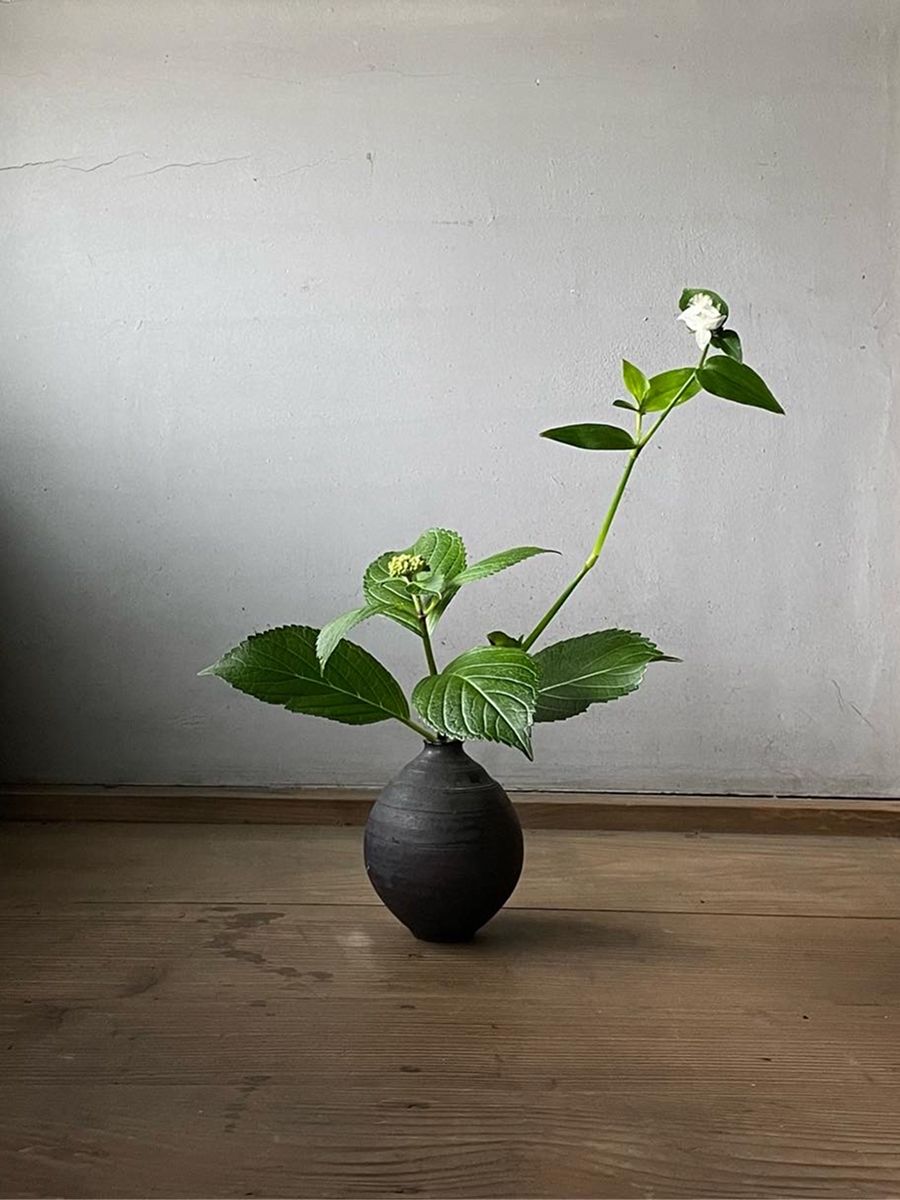
Arranging flowers from the garden and changing the hanging scroll with the seasons. Practising calligraphy, painting, and making things as part of everyday life. In designer Midori Saito’s account of her grandmother’s life, there is no boundary between creating and living. That example quietly carries through into Saito’s own study of calligraphy and ikebana today. She now devotes only half the week to design work, valuing time to learn and work with her hands for herself. Even when writing the same character, a different line emerges each time. Flowers take on forms that can only be encountered in that moment. These unrepeatable experiences of beauty are gradually changing the way she sees the design practice she has known for so long.
Listening to her, inheriting something from another person and searching for an expression of one’s own begin to seem less like separate pursuits. She explores her grandmother’s way of life and her teachers’ ideas with her own hands, interpreting them in her own way, with the possibility of one day passing them on to someone else. What began as learning to care for the things she loves has come to shape Saito’s own way of living.
An Unrepeatable Trace Arises in the Here and Now
—A Dialogue Grounded in Beauty
Patmos Editorial Team (P): We understand that you currently limit the time you spend on design as a livelihood to half the week, and practice ikebana and calligraphy as part of your daily life. From that, it seems you may be gradually moving away from Western design thinking, with an awareness of Japanese beauty now underpinning your sensibility. How do you see it yourself?
Saito: Yes… I am drawn to fluctuations and things that happen only once, and I think I have a strong desire to learn a sensibility that cherishes what exists only here and now. I began studying ikebana and calligraphy because I wanted to embody that spirit of Japanese beauty.
P: Has studying ikebana and calligraphy in earnest made you realize anything?
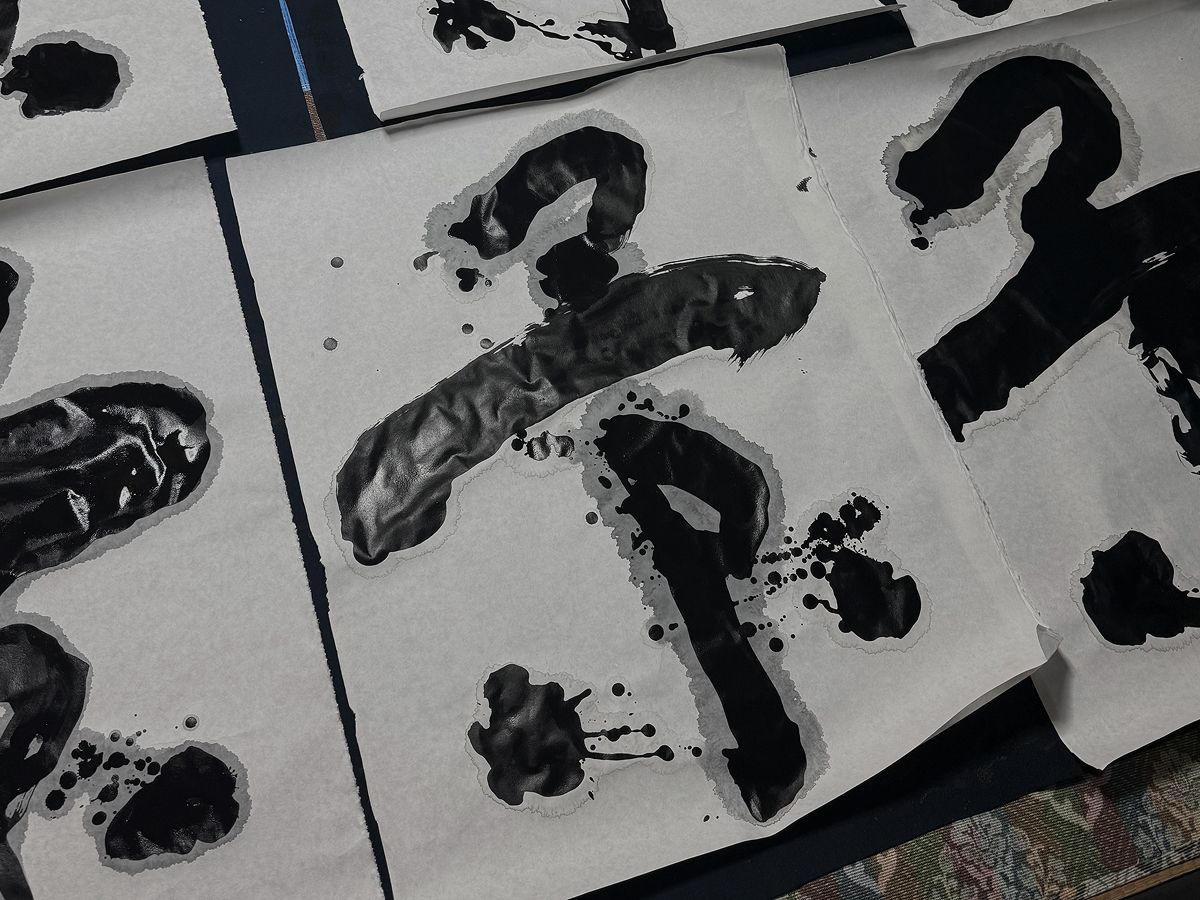
Saito: When I first started, I was struck by how ikebana and calligraphy seem to have rules and correct answers, yet in fact have no absolute prescriptions. Take the character for “black,” for example: rather than making the three right-hand dots among the four at the bottom identical, calligraphy has a sensibility that finds it beautiful to vary their size and shape, giving each a slightly different nuance. Similarly, writing a symmetrical character with literal symmetry is not considered especially appealing or beautiful. If the left is thin, make the right thick; vary the weight on either side, or write it at a slight angle. The aim is asymmetry with balance. There is something fascinating about being able to write a different character every time by judging each character’s beauty and harmony in the moment.
P: Having worked in design for so long, perhaps you unconsciously held a standardized ideal of beauty. Was that why it surprised you?
Saito: I had been working in design for nearly ten years, so I suppose I did… And lately, whatever design I look at, I feel as though I have seen it before. I seem to find fewer things interesting or compelling.
P: I see.
Saito: Design, to begin with, is not simply about making something and stopping there. It assumes that what you make will be handed to someone else. And because considering ease of use for a particular person is essential, reproducibility and clear rules matter too. I do not mean to be provocative, but while keeping those fundamentals of design as a foundation, I hope to weave the personal sensibilities and unrepeatable beauty I have gained from calligraphy into my own design work. It is all right to express more of yourself; we do not all have to write the same characters. Through lessons like these from calligraphy, I feel as though I have installed a new set of values within myself.
Simply Cherish What You Can Hold Dear
—A Dialogue Grounded in Truth
P: Was taking up ikebana and calligraphy what prompted you to shift toward your current balance of life?
Saito: Indirectly, perhaps, but I think several things came before that. To start with the most immediate, I wanted time to make something that arose within me as an expression of my own, rather than something someone had asked me to make.
P: Looking back over your life, that seems like a very interesting change.
Saito: Yes… I went to university twice and went through the job-hunting process twice, but until that first round of job hunting, I had never really thought seriously about my life. I had more or less gone along with those around me, and things had gone fairly smoothly, so for some reason I imagined I would just keep moving with the flow. Besides, I had never really understood what an office worker was—what those people actually did. I grew up in a part of Fukushima that was neither urban nor rural. My parents and grandparents were all schoolteachers, and there were no adults around me with what you would call company jobs. Even when I heard descriptions of the work at recruitment sessions, my honest reaction was, “That does not sound fun at all. I do not want to do it.” But advertising design was the one job I came across that sounded interesting. That was the first time I learned that being a designer was a profession. I was surprised that drawing and making things, which I had loved so much as a child, could be a way of living that genuinely connected me to society. I really felt, “Maybe this is what I have wanted to do.”
P: From what you have told us, there were opportunities to choose something related to art at various turning points—school clubs in junior high, or applying to university. But for different reasons, you did not take those paths.
Saito: That is right. The choices I made naturally took me away from making things, but I have always been someone who could draw for hours without getting bored. As a little girl, I drew and made things with my grandmother. In elementary school, I drew illustrations and comics whenever I had time, from recess to class. In high school art lessons, I sometimes stayed behind on my own and kept painting until I was satisfied. Even after enrolling in an English literature program, I paid my own way to an art camp overseas. At different points I kept being drawn to art and making things… yet for a long time, I shut away what I really loved and tried not to look at it. That was why I decided that if I found something I could truly cherish, I would take proper care of it, along with the feeling that made it precious. There was a time when I felt inadequate because I had nothing I loved enough to talk about with other people.
Perhaps I Am Following in My Grandmother’s Footsteps
—A Dialogue Grounded in Beauty
P: The foundations of our sensibilities are often formed early in life. You have mentioned that your family had a significant influence on yours.
Saito: I think my grandmother taught me that creating is not something exceptional; it is part of everyday life. After retiring, she taught calligraphy at home, and I took lessons from her until high school. I remember her shutting herself in a room on weekends to work on very large pieces, perhaps because she also exhibited her own work as a calligrapher. She had many interests beyond calligraphy, taking some kind of lesson almost every day—yoga, swimming, haiku, haiga painting, torn-paper collage. When I was small, I would go along, and I remember playing beside her as she did her assignments, imitating what she was doing. Whenever I had free time, I was with her, drawing or folding origami. I loved her so much that we kept an exchange diary, even though we lived in the same house.
P: What a rich way of life. It seems as though your own life is now moving closer to hers.
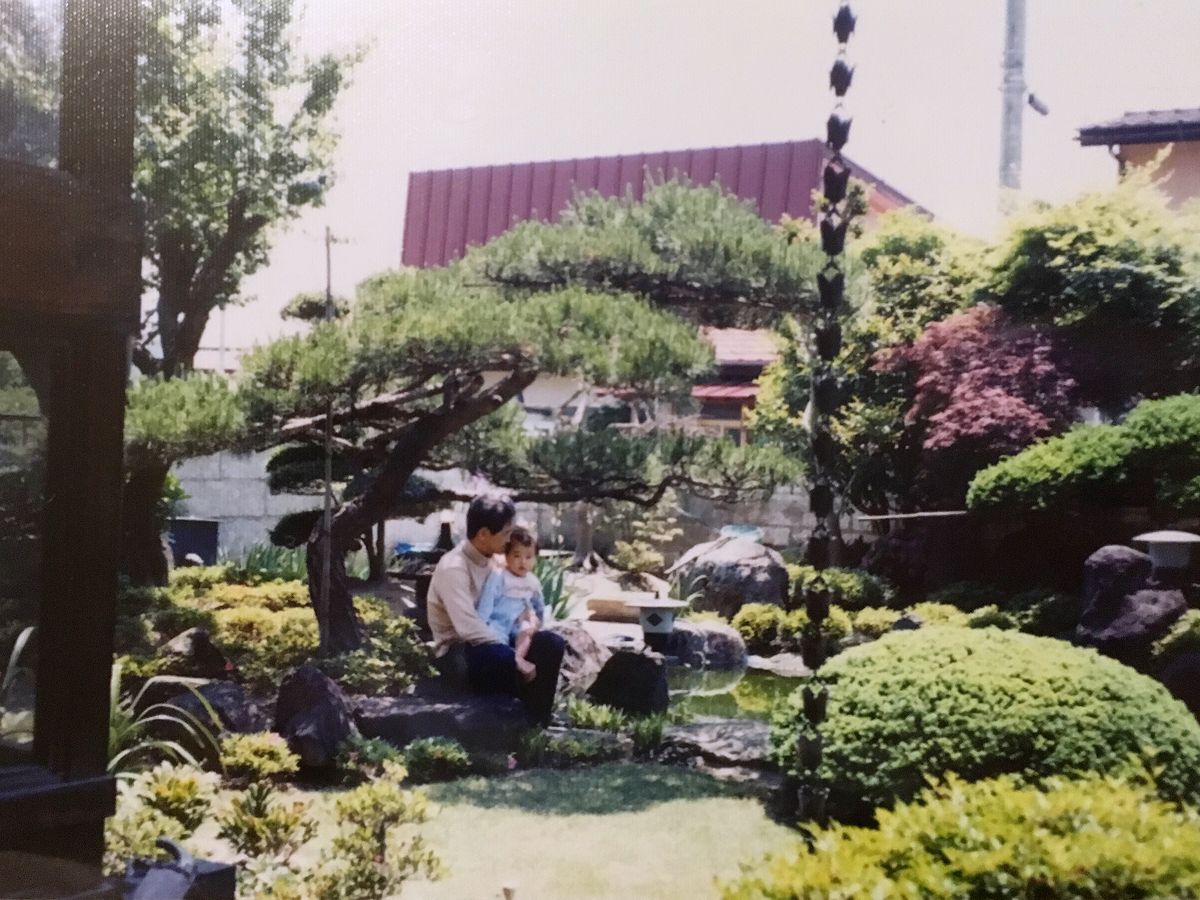
Saito: I feel that very strongly too. She never explicitly taught me about Japanese culture, but as someone of her generation, I think those sensibilities were simply part of her. Although she had never studied ikebana, she would arrange flowers from the garden as the seasons changed, or change the hanging scroll. It was a Japanese garden, large enough for children to run around in, with a pond, pines, plum trees, and maples. Living in the Tokyo area, I had thought there was little opportunity to sense those subtle transitions in nature. Through ikebana, I hope to come even a little closer to the way my grandmother lived and saw things.
P: This may be asking the obvious, but do you like nature?
Saito: I do. Until I moved to Tokyo, I was surrounded by nature and never gave it much thought. I realized it after leaving home.
P: Sometimes it takes leaving to notice something.
Saito: It really does. Looking back now, I think my mother, who taught mathematics and science, worked hard to help me discover how interesting nature was and experience it firsthand. She once picked up a dead bat by the roadside and spread its wings, saying, “Aren’t bats cute?” Or she would wake me at two or three in the morning so we could go and watch a meteor shower together.
P: Those are very direct encounters with nature.
Saito: Seasonal traditions mattered in our family, and there were things to do throughout the year that belonged to each season. In spring, we dug bamboo shoots in a nearby grove; in autumn, we picked mugwort from a vacant lot and made dumplings. Since leaving home, I have grown distant from all that, but things imprinted on you as a child do remain. I still think, “There really is something lovely about that.” Those memories may be part of what draws me to ikebana, connecting me to opportunities to really feel the changing seasons and to sense the natural forms of plants even inside the house.
P: Do you feel that something like mono no aware—an awareness of the poignancy of things—has become part of you? We would like to hear how you think about being moved, or quietly touched by something, before explaining it through logic or words.
Saito: Well… When it comes to words, I do feel a kind of strain in the way everything proceeds under their direction. Because we humans have language, we try to communicate everything through it. But plants do not, do they? I feel them saying, through something other than words, “This is how I am right now,” “I am doing well,” or “I need water.” I think that is part of communication too. Even between people, it makes me happy when we understand each other through a nonverbal exchange.
Questions for Others Came Back to Me
—A Dialogue Grounded in Truth
P: You then enrolled at art university and began your career as a designer. Did valuing your own feelings remain a guiding principle during that time?
Saito: Hmm, I wonder. Honestly, at art university I did not have much room to think about that. I decided to apply while job hunting after studying English literature, and entered after only a few months of preparation for the entrance exam. I kept thinking, “Everyone is so good at drawing, and I am not.” I had never used design software before enrolling, so learning it took all my energy. After graduating, as I began working in design… I had always loved making things, and had chosen this path to honor my own feelings. But as I received different opinions from different people, I sometimes lost sight of what I had been aiming for. At times, a project would end without my feeling entirely satisfied with what I had made.
P: Over time, did a desire to be as you wished, without anyone else’s interference, lead to your current way of life?
Saito: Yes. There were also things I realized after joining Patmos. Its way of working is rather distinctive. We conduct extended interviews and research with a client, then build a brand archetype and reconstruct the brand’s personality. As I went through that process, I began wondering, “What kind of brand am I?”
P: The question came back like a boomerang, making you realize that you, the person asking, did not really understand yourself.
Saito: Exactly. I thought, “I ask other people these things, but I have hardly thought about myself.” From there, I began looking more deeply into what kind of person I wanted to become and what I liked.
P: And that led to a life that gives more weight to learning as a way to know and cultivate yourself.
Saito:
Yes. I am simply at home on my own, quietly working with my hands, but every day feels fulfilling—so much so that I feel I need nothing else. Of course, my previous life was more than enough too, but this gives me a sense of satisfaction beyond enjoyment. Before, I had only known the happiness of enjoying time with someone or sharing that enjoyment. Now it is more like keeping myself company. Perhaps it is similar to loving yourself, but I feel as though the “me” who is my own partner is making me happy.
P: Do you find joy in learning?
Saito: I do. I think it is one of the things that make me who I am. Sometimes I learn for work, but mostly my desire is to explore things that interest me more deeply. It is curiosity: simply wanting to know, wanting to see. And I do not just want to know about something; I want to be able to do it myself.
P: Is it a desire to acquire tacit knowledge through practice, rather than simply accumulate information?
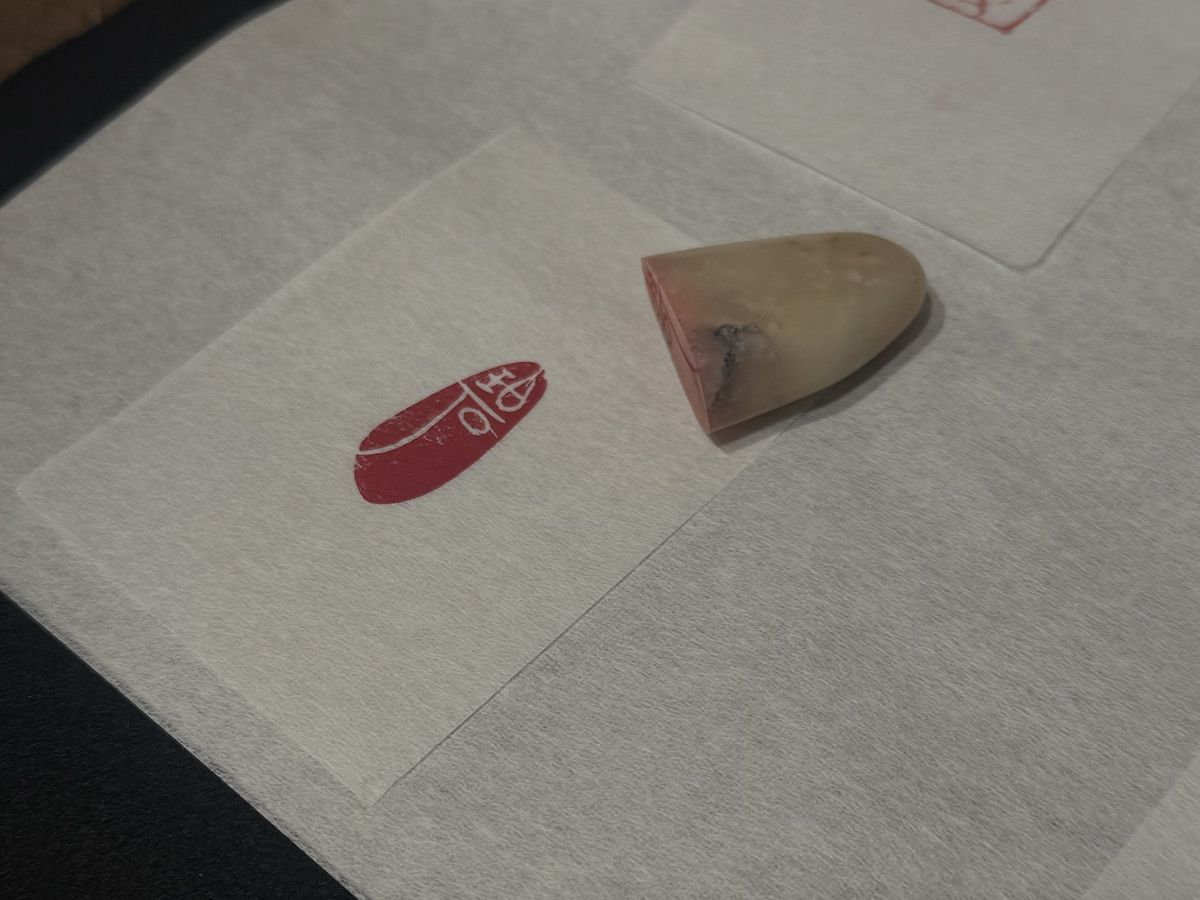
Saito: Yes. Lately, I have been consciously choosing to learn things that can nourish and improve my nonverbal expression. Even in calligraphy, although I am writing characters, something arises from the act itself, or emerges without conscious intention through moving my body. I want to acquire, through practice, what can only be gained through doing.
P: Beyond calligraphy, traditional arts such as the tea ceremony and flower arranging are founded on acquiring a distinctive expression or understanding through rigorous imitation and repetition. Your thinking seems connected to that.
Saito: Yes. In that sense, finding a good teacher matters to me—placing myself close to someone I aspire to be like, because I can be quite influenced by those around me. When I encounter the thinking and work of people I want to follow every day, I feel I can naturally move closer to them.
For example, you do not have to graduate from art university to become a designer. Even so, I am glad I went because I learned about design that could guide how I wanted to live, and through meeting the professors, I came to understand their approaches to work. To be honest, the philosophical things I learned at university did not seem particularly useful in day-to-day professional work, and there was a time when I almost lost sight of why I had gone. But there are designers and professors, Kenya Hara among them, who genuinely bring their design philosophy into their work. I hope to be able to work like that one day, and I think having them as models has helped me keep making an effort. It is the same with calligraphy. Even if someone is far beyond where I am now, I think it is tremendously important to search for a person whose work makes me think, “I would love to make something like that,” and learn from them as a teacher.
P: We completely agree that finding a good teacher is a way to learn well through imitation.
Saito: I think what you learn is the inner part—the thinking that leads your teacher to do what they do. How you express that outwardly is precisely where individuality comes in. You can take inspiration from the inner core, but you have to think for yourself about how to interpret it and give it expression.
P: It takes a long time to make the spirit of shu-ha-ri—following, breaking with, and moving beyond established forms—your own. Do you find that process difficult?
Saito: Trial and error is definitely fun. Well, it is incredibly painful, actually! [Laughs.] But looking back, I always feel that it really did work like strength training. So I do not dislike it at all. Even when I remember getting into art university, what stays with me more strongly than “I got in! I did it!” is the time I spent drawing with everything I had, day after day. I truly love those hours of concentration when I am making or drawing something. Perhaps that is what matters most to me.
Recognizing Subtle Differences Reveals Where You Stand
—A Dialogue Grounded in Goodness
P: Do you ever judge things in terms of right and wrong?
Saito: Hmm, I wonder. In personal matters, I may not think very much about whether something is right or wrong. I think I tend to give priority to feelings—whether I like something or not.
P: Do you feel it is impossible for a third party to objectively declare something right or condemn it? Is that a principle that comes from believing things have many sides?
Saito: Yes… I think so. In Japan, many people share similar cultural and educational backgrounds, so I feel we have fewer opportunities than people abroad to encounter opinions arising from completely different assumptions. In another country, a third perspective from an entirely different angle might emerge. So I think what we consider right is shaped by the environment we were born into; there is no absolute rightness.
P: Apparently, there is a people on an island in Southeast Asia whose culture has no concepts of gratitude, apology, or ownership. Even in this contemporary world, where ideas become standardized commodities, looking around the globe reminds us that countless people have entirely different kinds of common sense.
Saito: That is true. I want to learn about those things I do not know, to broaden my own possibilities. Knowing that all kinds of people exist in the world can be reassuring, can’t it? Even if you want to live as freely as possible, it is frightening to be the first to choose a path no one has taken. I hope to understand where I stand by learning about people whose lives are close to mine, but a little different.
P: Learning how people similar to you, but slightly different, live. That seems a way to bring your actual position into focus.
Saito: If their circumstances and environment are too far removed from mine, they feel like people in a fantasy world. But if someone was born in the same country and grew up in a similar environment, with just something a little different, I can relate it to myself. I can think, “That could have been me.”
P: You bring an imagined version of yourself into the picture as a point of reference for making decisions.
Saito: Often I cannot imagine it very well, but when I am unsure about a decision or something difficult happens, I sometimes use it as a clue. In the end, it is often about appreciating my own happiness.
Mastering a Skill Also Means Passing It On
—A Dialogue Grounded in Gestalting
P: Do you think anything in this world lasts forever?
Saito: That is a difficult question… To start with, I do not think anything can exist unchanged forever. Some things keep changing form or are passed on to someone else, but I am not sure whether that fits the definition of lasting forever.
P: Once its state changes, the concept or thing in question is no longer the same.
Saito: Yes. In the Ohara School of ikebana, which I joined, you can take students once you receive a teaching certificate, but apparently only a handful actually become teachers. My teacher was concerned about that. I remember being told, “Only by teaching others do you recognize your own shortcomings and immaturity, and become truly capable of being a teacher,” and, “Ikebana has been passed down for hundreds of years. If you benefit from that traditional culture as a learner, is it not disrespectful to avoid passing the skills you have acquired on to the next generation?” When I heard that, I thought, “That is true.” I realized that learning a traditional culture also means being conscious that I am someone who must connect it to others. Conversely, I realized that I too could become part of that lineage. In the Ohara School, there is more to learn even after receiving a certificate, so reaching a point where you can teach is not the goal. Passing it on to someone matters more than the quality of your teaching.
P: A school or lineage is defined as a group that passes on formalized skills through hereditary or teacher–student systems. In ikebana, tea ceremony, and martial arts alike, the original focus is on transmitting those skills. In that case, from the moment you become a student, you also take on the responsibility of handing them to someone else.
Saito: Yes. It is easy to think that paying a monthly fee lets us learn without responsibility, and that what we receive is simply what we are owed in return. But learning a traditional art means I too have a responsibility to pass on those skills, just as those before me did. I think I was made to realize that this is how I should be.
P: Carrying on a tradition of skills is important, but arranging wildflowers at home so that visiting friends can sense the presence of nature and the changing seasons you have known since childhood also seems like a way of passing something on that is distinctly yours. Including things like that, would you like to take action to share something with others?
Saito: I would love to be able to do that. I do not know how far I can take it, but I hope I can work toward it.
-
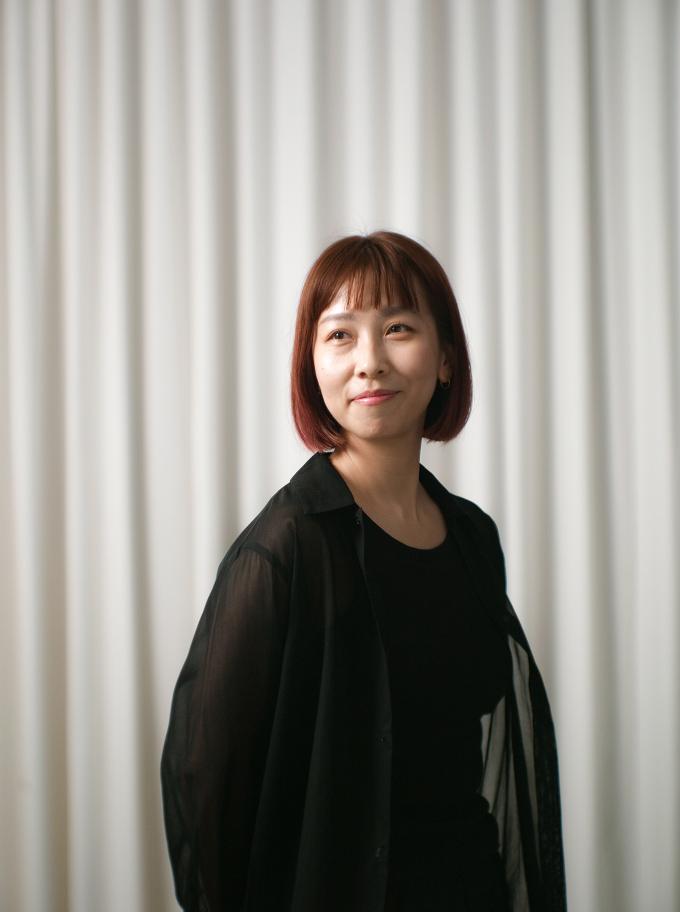
Art Director, Designer / Born in Fukushima, Japan, in 1988. She seeks to create design that allows the values of people and brands to be experienced naturally, placing importance not only on how things look, but also on communicating the ideas and intentions behind them. She currently studies Japanese calligraphy and ikebana, deepening her appreciation of the aesthetics and ways of being embedded in Japanese culture. For her, richness lies in embracing the changing seasons and remaining open to whatever captures her curiosity along the way.